
Timothy Green’s Currency
In 1776, Connecticut needed money. The General Assembly directed Timothy Green to print this paper currency.
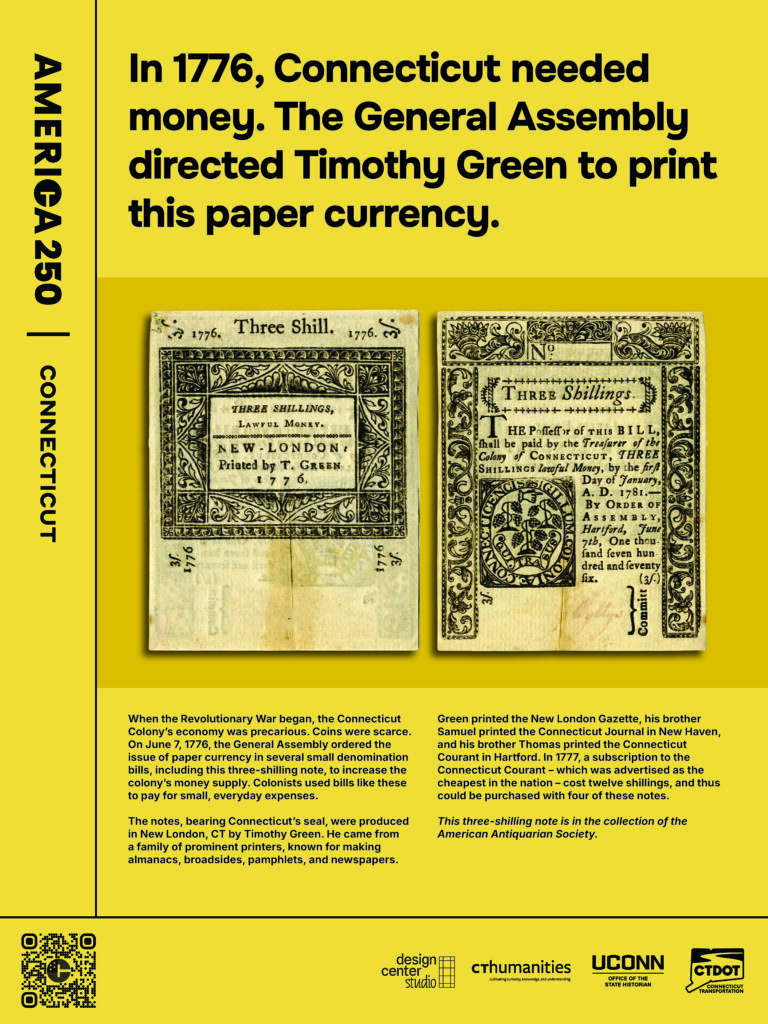
When the Revolutionary War began, the Connecticut Colony’s economy was precarious. Coins were scarce. On June 7, 1776, the General Assembly ordered the issue of paper currency in several small denomination bills, including this three-shilling note, to increase the colony’s money supply. Colonists used bills like these to pay for small, everyday expenses.
The notes, bearing Connecticut’s seal, were produced in New London, CT by Timothy Green. He came from a family of prominent printers, known for making almanacs, broadsides, pamphlets, and newspapers. Green printed the New London Gazette, his brother Samuel printed the Connecticut Journal in New Haven, and his brother Thomas printed the Connecticut Courant in Hartford. In 1777, a subscription to the Connecticut Courant – which was advertised as the cheapest in the nation – cost twelve shillings, and thus could be purchased with four of these notes.
This three-shilling note is in the collection of the American Antiquarian Society.
Credits
Timothy Green’s Connecticut currency is in the American Antiquarian Society in Worcester, MA.