
Phillis Wheatley’s Letter
In 1774, Phillis Wheatley wrote to Samson Occom about slavery, freedom, and natural rights. The Connecticut Gazette printed her letter.
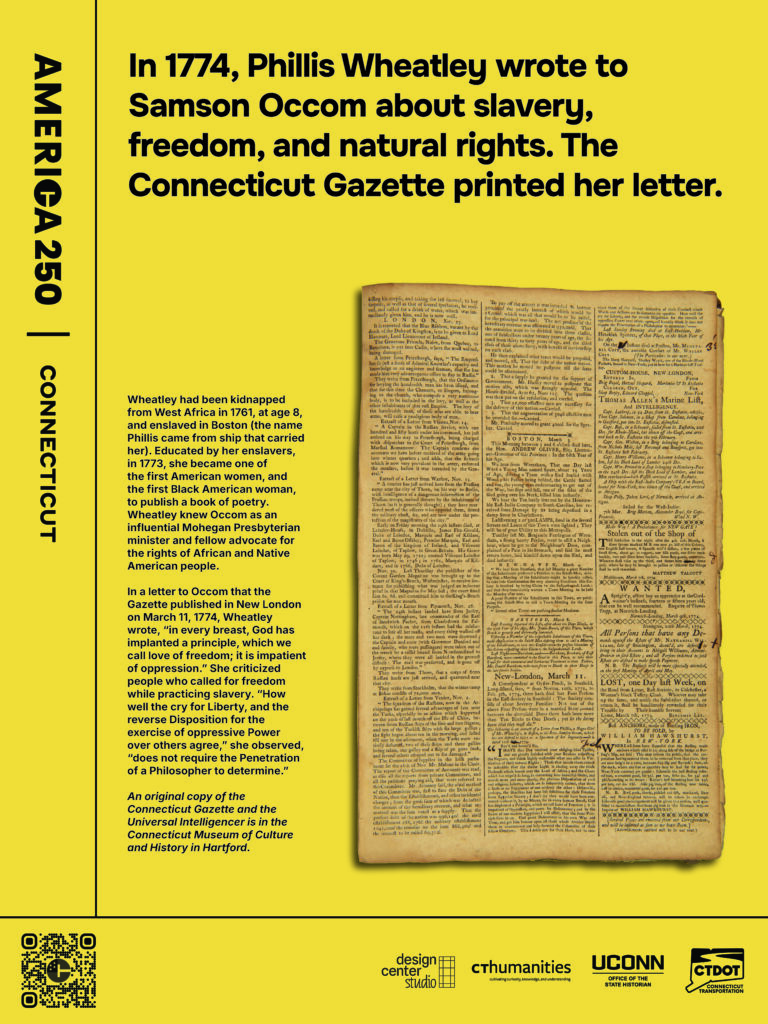
Wheatley had been kidnapped from West Africa in 1761, at age 8, and enslaved in Boston (the name Phillis came from ship that carried her). Educated by her enslavers, in 1773, she became one of the first American women, and the first Black American woman, to publish a book of poetry. Wheatley knew Occom as an influential Mohegan Presbyterian minister and a fellow advocate for the rights of African and Native American people.
In a letter to Occom that the Gazette published in New London on March 11, 1774, Wheatley wrote, “in every breast, God has implanted a principle, which we call love of freedom; it is impatient of oppression.” She criticized people who called for freedom while practicing slavery. “How well the cry for Liberty, and the reverse Disposition for the exercise of oppressive Power over others agree,” she observed, “does not require the Penetration of a Philosopher to determine.”
An original copy of the Connecticut Gazette and the Universal Intelligencer is in the Connecticut Museum of Culture and History in Hartford.
Credits
The Connecticut Gazette and the Universal Intelligencer with Phillis Wheatley’s letter to Samson Occom is in the Connecticut Museum of Culture and History in Hartford.