
Newgate Prison
During the Revolutionary War, loyalty to Britain became illegal, and the Simsbury Mines became Newgate, “a prison for the confinement of Loyalists in Connecticut.”
After copper was discovered in the East Granby section of Simsbury, townspeople incorporated North America’s first chartered copper mine there in 1707. The mine was operated sporadically until 1773, when the Connecticut Colony purchased the site to use as a prison and renamed it after a notorious London prison: Newgate. Connecticut’s Newgate started holding Loyalist prisoners in 1775. Officials hoped the prison would be impenetrable, but a series of escapes proved otherwise, so they made the prison ever more constraining.
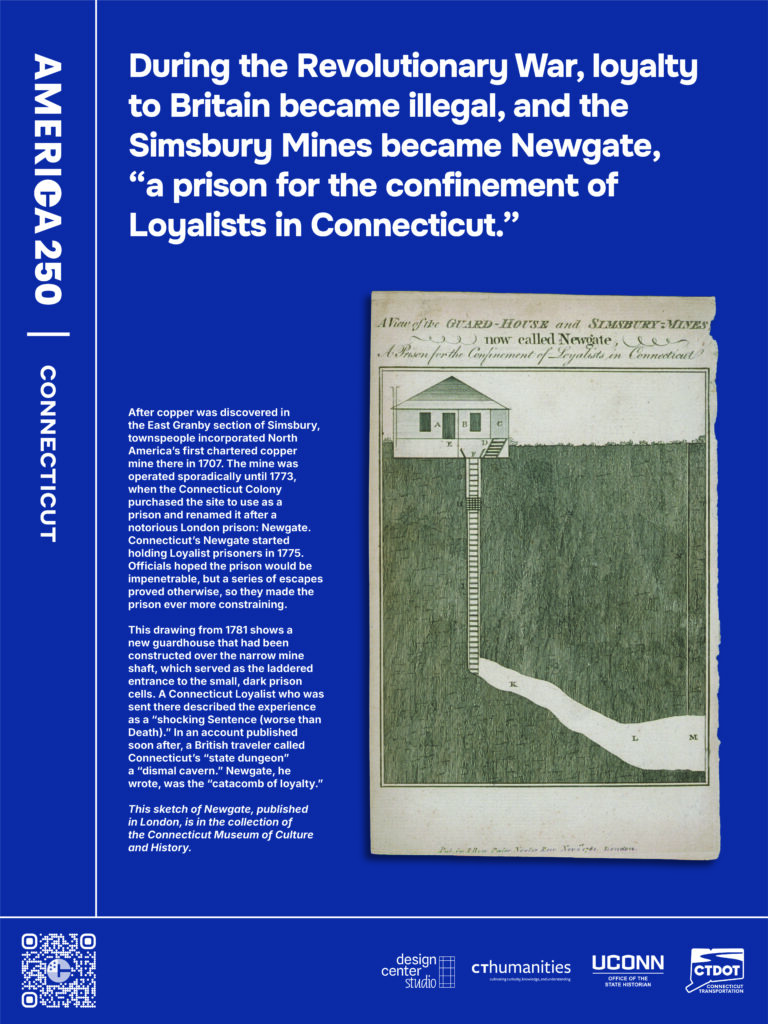
This drawing from 1781 shows a new guardhouse that had been constructed over the narrow mine shaft, which served as the laddered entrance to the small, dark prison cells. A Connecticut Loyalist who was sent there described the experience as a “shocking Sentence (worse than Death).” In an account published soon after, a British traveler called Connecticut’s “state dungeon” a “dismal cavern.” Newgate, he wrote, was the “catacomb of loyalty.”
This sketch of Newgate, published in London, is in the collection of the Connecticut Museum of Culture and History.
Credits
The sketch of Newgate Prison is in the collection of the Connecticut Museum of Culture and History in Hartford.