
King George’s Statue Fragment
Patriots toppled a statue of King George III and used its lead for bullets. This piece survived.
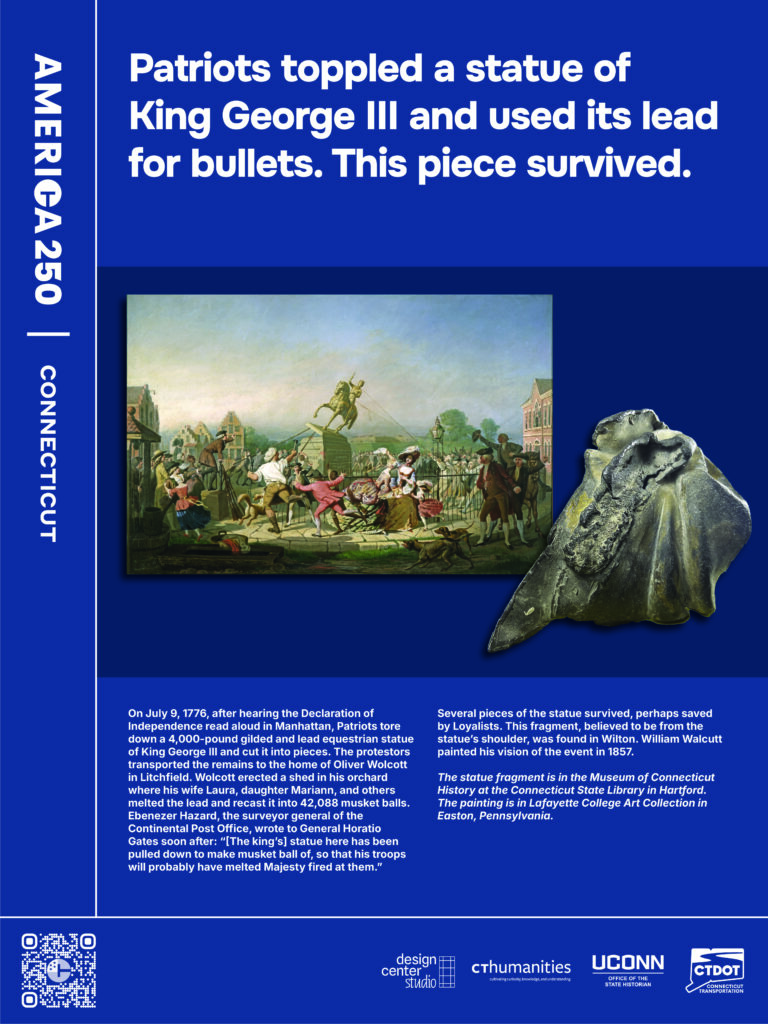
On July 9, 1776, after hearing the Declaration of Independence read aloud in Manhattan, Patriots tore down a 4,000-pound gilded and lead equestrian statue of King George III and cut it into pieces. The protestors transported the remains to the home of Oliver Wolcott in Litchfield. Wolcott erected a shed in his orchard where his wife Laura, daughter Mariann, and others melted the lead and recast it into 42,088 musket balls. Ebenezer Hazard, the surveyor general of the Continental Post Office, wrote to General Horatio Gates soon after: “[The king’s] statue here has been pulled down to make musket ball of, so that his troops will probably have melted Majesty fired at them.” Several pieces of the statue survived, perhaps saved by Loyalists. This fragment, believed to be from the statue’s shoulder, was found in Wilton. William Walcutt painted his vision of the event in 1857.
The statue fragment is in the Museum of Connecticut History at the Connecticut State Library in Hartford. The painting is in Lafayette College Art Collection in Easton, Pennsylvania.
Credits
King George’s statue fragment is in the Museum of Connecticut History at the Connecticut State Library in Hartford.