
John Dunlap’s Declaration of Independence
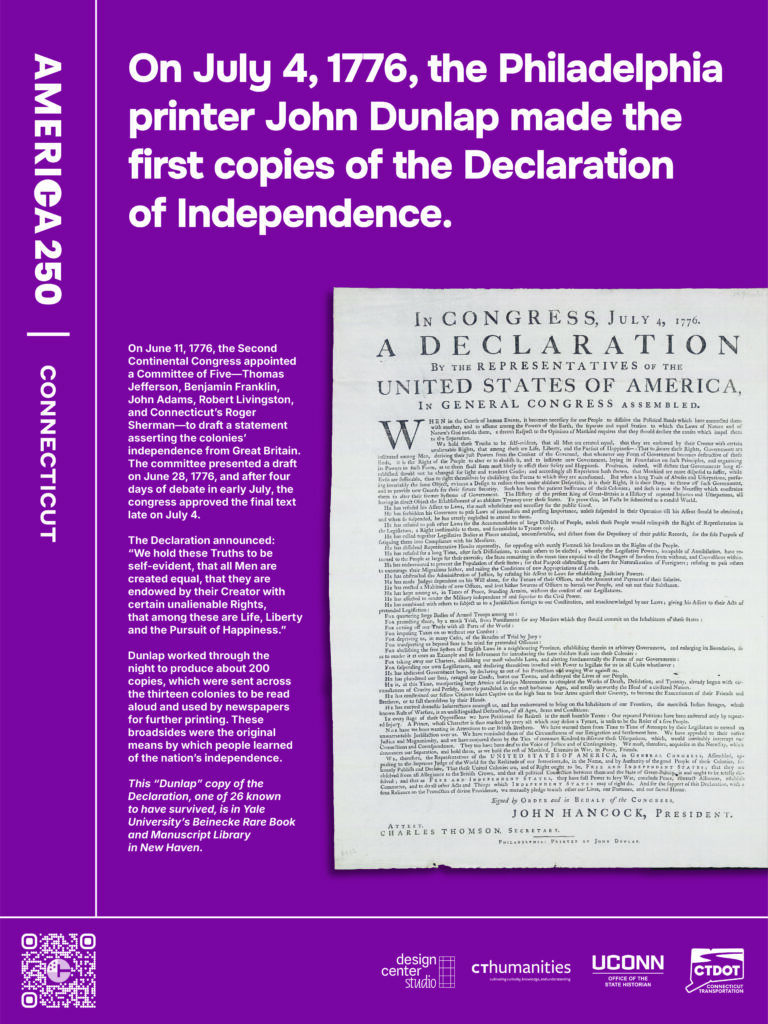
On July 4, 1776, the Philadelphia printer John Dunlap made the first copies of the Declaration of Independence.
On June 11, 1776, the Second Continental Congress appointed a Committee of Five—Thomas Jefferson, Benjamin Franklin, John Adams, Robert Livingston, and Connecticut’s Roger Sherman—to draft a statement asserting the colonies’ independence from Great Britain. The committee presented a draft on June 28, 1776, and after four days of debate in early July, the congress approved the final text late on July 4.
The Declaration announced: “We hold these Truths to be self-evident, that all Men are created equal, that they are endowed by their Creator with certain unalienable Rights, that among these are Life, Liberty and the Pursuit of Happiness.”
Dunlap worked through the night to produce about 200 copies, which were sent across the thirteen colonies to be read aloud and used by newspapers for further printing. These broadsides were the original means by which people learned of the nation’s independence.
This “Dunlap” copy of the Declaration, one of 26 known to have survived, is in Yale University’s Beinecke Rare Book and Manuscript Library in New Haven.
Credits
John Dunlap’s Declaration of Independence is in Yale University’s Beinecke Rare Book and Manuscript Library in New Haven.