
Job Lathrop’s Freedom
Job Lathrop was enslaved when he served in the Continental Army. On June 2, 1778, Caleb Huntington secured his freedom.
Lathrop was born into slavery in Norwich, CT, probably in 1753. He was the son of Venus and Primus Armes, who had been kidnapped from The Gambia. In March 1776, Lathrop enlisted in the 20th Continental Regiment. He served at the Battle of Trenton that December and was discharged six days later.
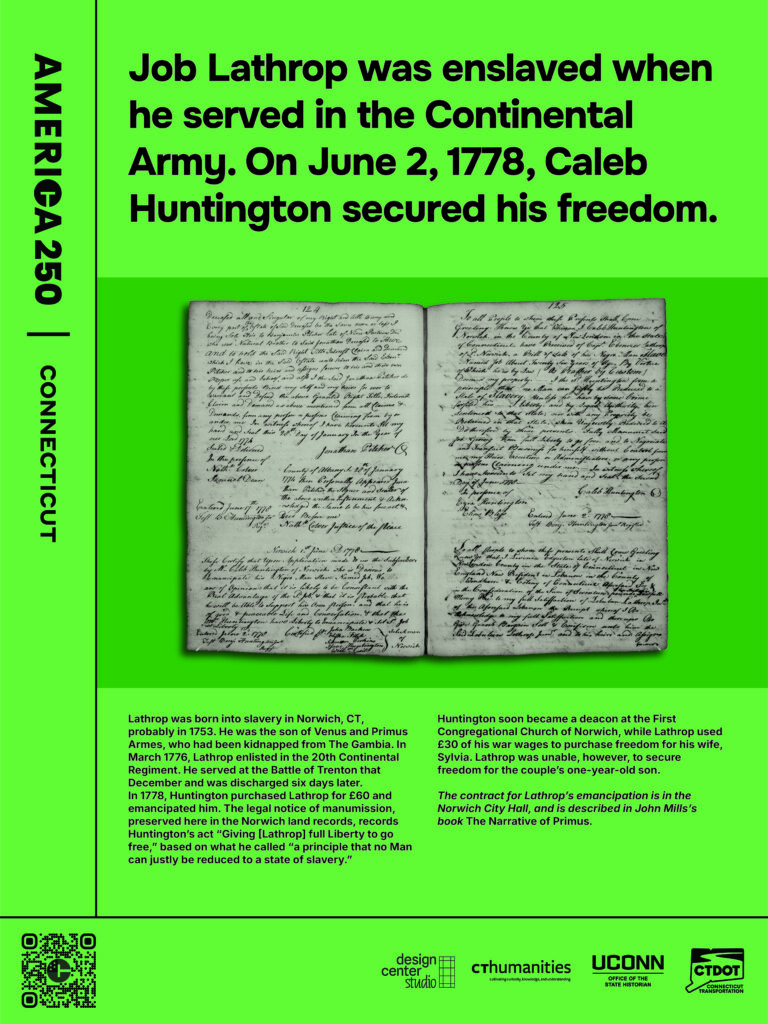
In 1778, Huntington purchased Lathrop for £60 and emancipated him. The legal notice of manumission, preserved here in the Norwich land records, records Huntington’s act “Giving [Lathrop] full Liberty to go free,” based on what he called “a principle that no Man can justly be reduced to a state of slavery.”
Huntington soon became a deacon at the First Congregational Church of Norwich, while Lathrop used £30 of his war wages to purchase freedom for his wife, Sylvia. Lathrop was unable, however, to secure freedom for the couple’s one-year-old son.
The contract for Lathrop’s emancipation is in the Norwich City Hall, and is described in John Mills’s book _The Narrative of Primus_.
Credits
Job Lathrop’s emancipation contract is in the Norwich City Hall, and is described in John Mills’s book The Narrative of Primus.